The shape of the answer
Acme Capital is fictional. Its paths, fix and dollar figures are illustrative, built to show the shape of the answer. The dashboard, the step-by-step layout and the labels are the ones your own uploads get.
CyberTwin reads your firewall, identity and cloud configuration files and shows the attack paths to your crown jewels, the one change that cuts the most of them, and the loss range a year.
13 attack paths to 7 crown jewels
The one changeNarrow FortiGate policy 47, line 1292cuts 6 of 13 paths
Loss exposure a yearUp to $3.6MMODELED
See the whole sample →On a computer: paste your own configuration and see its attack paths.
Acme Capital is a fictional 200-person fintech. Below is its dashboard, as the app shows it: the routes from an entry point to the data that matters, the one change that breaks the most of them, and a dollar range labelled MODELED, drawn across 14 systems. Point at any path to select it everywhere.
Switch it to After the one change and every figure it touches changes with it. Point at a node, a row or a column to select that path.
11 systems sit on the attack paths, on 6 floors from the Internet down to the crown jewels. Sample data.
HQ FortiGate · firewall policy 47 · line 1292the finding Proven
You name the group: the clients that need prod-payments.
| # | Entry point and target | Steps | Frequency a year | Loss exposure a year | State |
|---|---|---|---|---|---|
| 01 | Exposed SSL-VPNPayments database | 9.9% | $102K–$846K | Open | |
| 02 | Branch ASACustomer data bucket | 8.2% | $74K–$596K | Open | |
| 03 | Phished CloudOps engineerStripe live keys | 6.7% | $84K–$680K | Open | |
| 04 | Phished CloudOps engineerStripe live keys | 6.7% | $84K–$680K | Open | |
| 05 | Phished Marketing userCustomer data bucket | 6.6% | $58K–$494K | Open | |
| 06 | Legacy sign-inCustomer data bucket | 6.6% | $58K–$494K | Open | |
| 07 | Phished CloudOps engineerGCP payments project | 5.8% | $108K–$890K | Open | |
| 08 | Phished CloudOps engineerAzure subscription | 5.7% | $91K–$767K | Open | |
| 09 | Okta sign-in pageStripe live keys | 5.1% | $63K–$522K | Open | |
| 10 | Public bucketReporting snapshots | 19.9% | $248K–$2.1Millustrative size | Open | |
| 11 | Internet via CloudflarePayments API origin | 19.9% | $248K–$2.1Millustrative size | Open | |
| 12 | Phished CloudOps engineerOutside mail recipient | not priced | no value set | Open | |
| 13 | Phished CloudOps engineerFalcon exclusion | not priced | no value set | Open |
Acme Capital is fictional. Its paths, fix and dollar figures are illustrative, built to show the shape of the answer. The dashboard, the step-by-step layout and the labels are the ones your own uploads get.
26 MITRE techniques map to specific edge types, and each path is matched against 11 named threat groups. Inferred edges are dashed and carry their reason.
On your own upload, a search runs from every entry point to every sensitive resource, and the single change that breaks the most paths is listed at the top, labelled MODELED.
Each file below is the report as it ships, built from the same Acme Capital estate. Sample: Acme Capital (fictional). Its figures carry their grade: PROVEN, OBSERVED, DECLARED or MODELED.
Five points in the order they are presented, each with its figure and its grade, and the decision asked for. The board pack below opens with it.
The quarterly board pack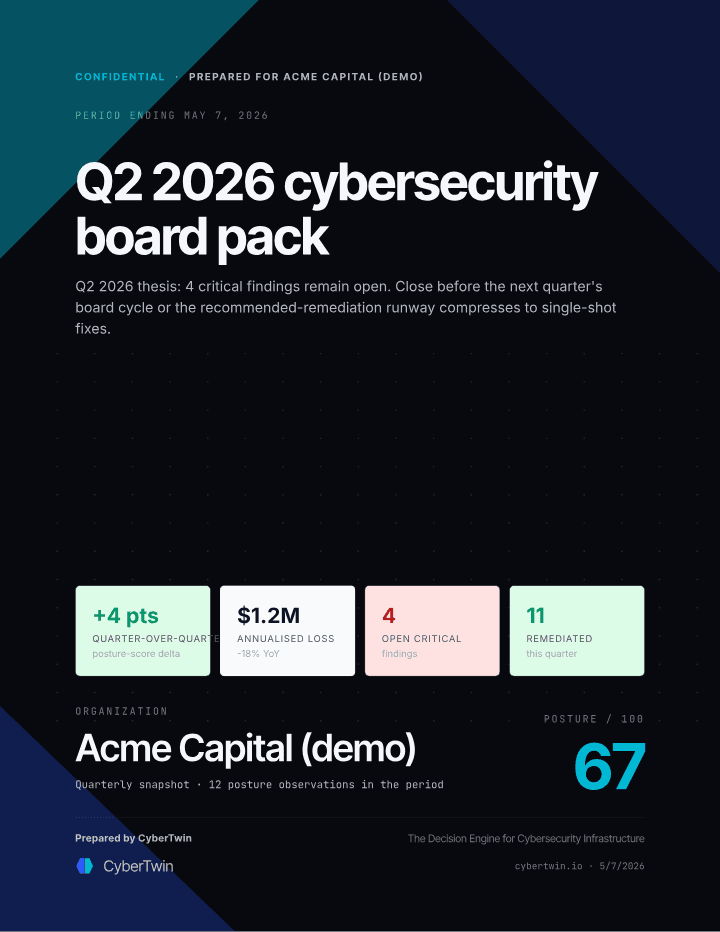 Sample company: Acme Capital (fictional)
Posture trend over twelve months, the annual loss as a modeled range year over year, the top open and closed critical findings, and framework coverage counted by the evidence behind each control.
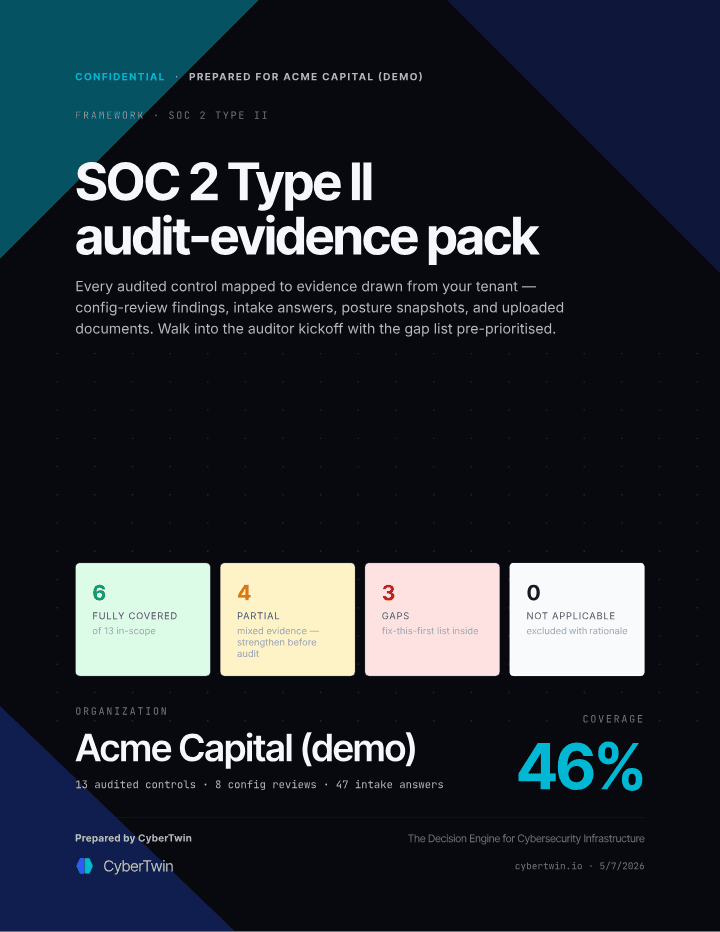 Sample company: Acme Capital (fictional)
Every audited control in SOC 2, ISO 27001, PCI DSS v4 and NCA ECC v2 mapped to its evidence: configuration findings, intake answers, posture snapshots and uploaded documents. Gaps ranked by effort, each with the fix.
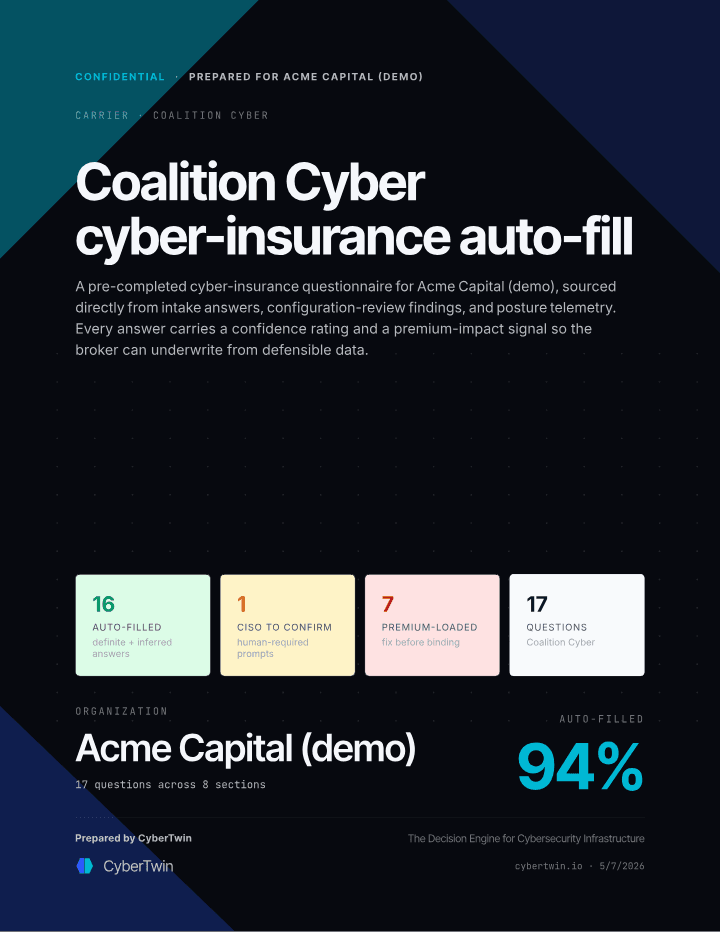 Sample company: Acme Capital (fictional)
Questionnaires for 5 cyber insurance carriers, filled in. Each answer carries a confidence tag (definite, inferred, needs a person) and a premium signal (helpful, neutral, loaded). Answers that load the premium lead the list.
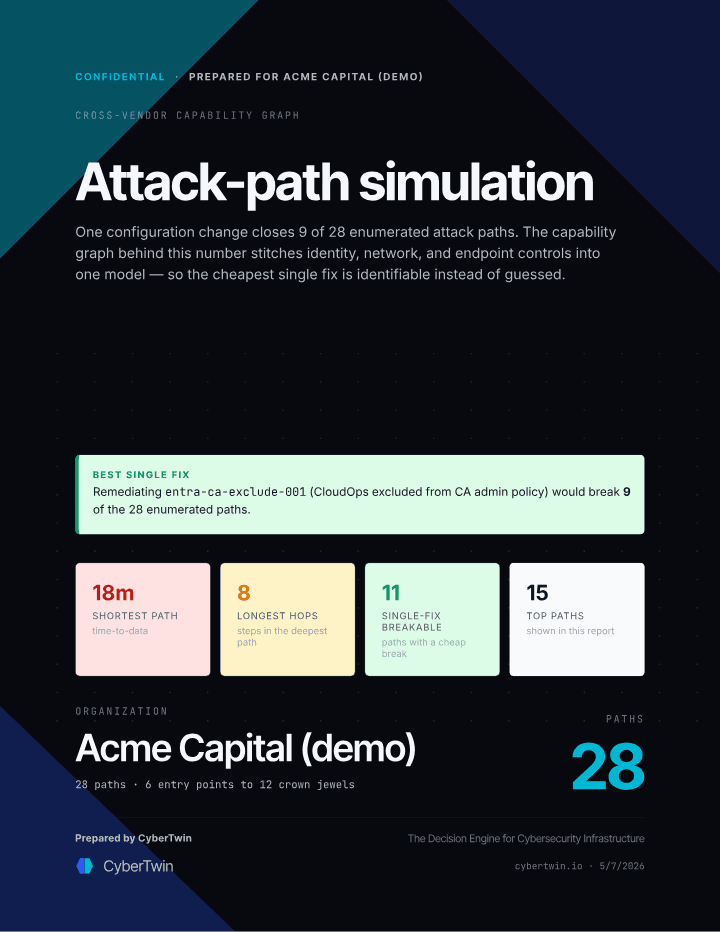 Sample company: Acme Capital (fictional)
Attack paths across the security tools you run. Uploads from 14 of them feed the graph today: Fortinet FortiGate, Palo Alto Networks PAN-OS, Cisco ASA / Firepower, Cisco Meraki, Microsoft Entra ID Conditional Access, Okta, AWS IAM, JumpCloud, Microsoft Defender for Office 365, Microsoft Defender Antivirus settings (one Windows device), CrowdStrike Falcon, Microsoft Sentinel, AWS Config, Cloudflare WAF. A search runs from each entry point to each sensitive resource. Edges carry their MITRE technique (26 distinct techniques), and paths are matched against 11 threat-actor categories.
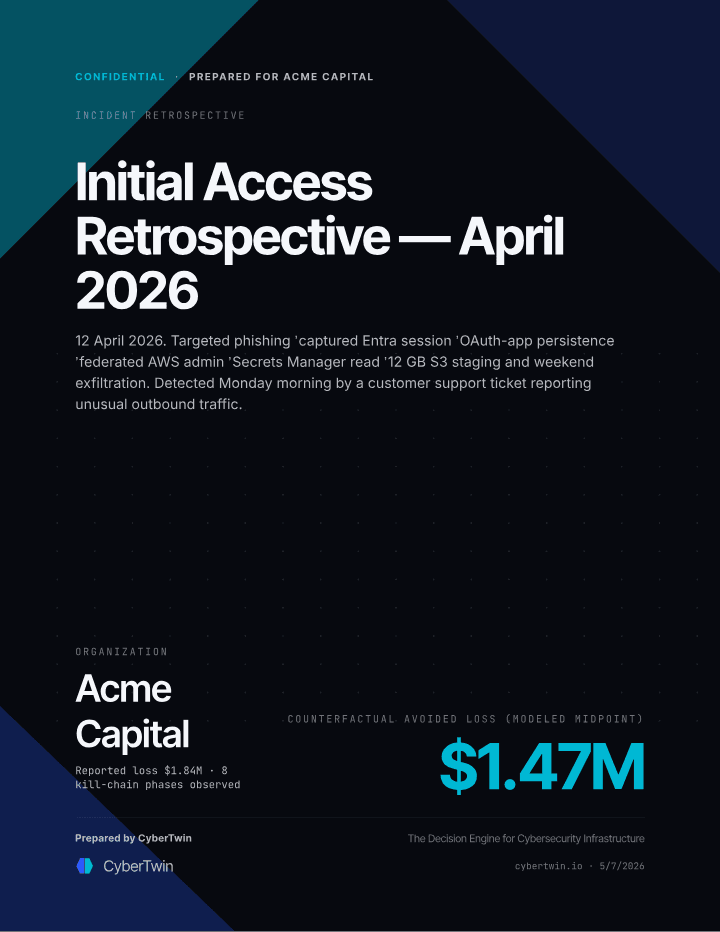 Sample company: Acme Capital (fictional)
Walks one incident through the MITRE kill chain and shows which open findings would have broken the chain at each phase, with the modeled loss that fix would have avoided. Used after an incident or to prepare a tabletop exercise.
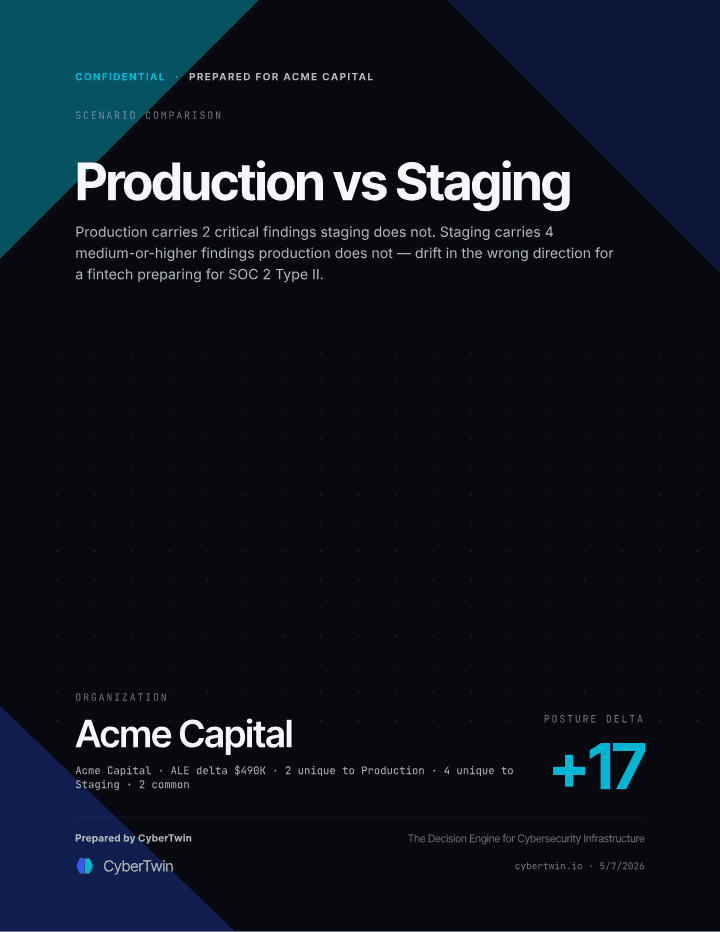 Sample company: Acme Capital (fictional)
Production against staging, or one region against another: findings, severity counts, framework coverage, intake answers and the modeled annual loss, side by side.
New Architecture, Architecture Review and Configuration Review each produce a different report. Here is the shape of each for Acme Capital, with the architecture diagram and the rules sheet. Sample: Acme Capital (fictional).
Engine output for the 200-person fintech / payments sample profile: the same run behind the fintech sample PDF. List prices dated 2026-09-25 · modeled, not a quote.
Leaves open: PCI design controls: configure on your firewall — see the app, Secrets scanning in source repos.
1 pick is not priced (Nightfall AI); the priced total excludes it, so fitting the $250,000 budget ceiling is unconfirmed; each pick says why.
Exceeds the stated $250,000 budget ceiling at list price.
Not a fintech, not 200 people? Build the three stacks for a company like yours →
The architecture, ready to hand to an engineer or auditor.
Tools grouped by architecture layer; edges show the protection and data-flow relationships the engine maps. Red-bordered nodes are the crown-jewel data stores. Export as SVG or PNG to hand to an auditor.
The sample FortiGate config's findings, sequenced by severity: Now, Next, Later.
The default sample is a fintech. Pick healthtech, SaaS, e-commerce or another sector to download a sample report for a fictional company in that industry, with its own vendors, frameworks and compliance scoring.
A sample record for the same fictional company: download it, then open it in the report checker. The check runs in your browser. Change any field and the checker refuses the file.
Drop a FortiGate policy block below. The engine extracts the network graph, traces one attack path, names a single choke-point fix, and gives a dollar range on industry defaults (range · MODELED). It reads one file, so it covers the network layer.
Your config is analyzed in your browser, inside a frame that cannot make network requests. Our server never receives it. Pastes are capped at 32 KiB. Without a workspace the sandbox runs once per browser and once per IP address per day; every IP address is limited to 8 runs in 5 minutes.
The engine answers with Lean, Balanced and Advanced stacks drawn from 101 catalog products: list prices with the date each was checked, the architecture they form and the order to deploy them. Each profile here is prebuilt from industry, size and region on a fixed sample company. No config is read, and nothing you pick is stored.
Sample profile: a 200-person SaaS / Software · GCC (Saudi Arabia) company reporting against NCA ECC, PDPL (KSA). One of 20 prebuilt profiles, modeled from two questionnaire answers on an otherwise fixed sample company. No config was read. Your run models your own answers to the full questionnaire.
The minimum a defensible program needs.
Leaves 1 lower-priority capability uncovered at this tier: Secrets scanning in source repos.
What most companies of this shape run.
Leaves 2 lower-priority capabilities uncovered at this tier: Secrets scanning in source repos; SAST integrated into CI.
Defence in depth for a mature program.
Exceeds the stated $250,000 budget ceiling at list price.
Every product docks into the zone it defends; the thin lines are telemetry into detection and response and the backup path out of Data. Empty zones are gaps this stack leaves open. They are named, not hidden.
Identity before the tools that depend on it; logging before the tools that feed it. About 28 person-weeks end to end. 7 of the 11 steps ship with a CyberTwin playbook — configuration, prerequisites, validation, compliance side-effects; the rest link the vendor's own setup docs.
Prices are vendor list prices, each verified on the date it carries (the oldest is 2026-09-25) — an estimate for budgeting, not a quote. A product with no published price is marked “not priced” and left out of the total, never counted as $0. Posture and dollars are modeled from the sample profile. Nothing here read a config or connected to anything: in the app the same engine models your questionnaire answers, and an uploaded config is graded separately, by config review. Coverage is scored against each stack's own target set, and a richer stack aims at a broader one, so compare stacks on posture, the single ruler applied to all three.
Prices are US list prices, each with its source and the date it was checked, and a stack total is a range. A product with no citable price says so and stays out of the total; it is never counted as $0. Setup guides are drafts your team reviews and applies: CyberTwin changes nothing on your systems.
The sample runs on a fictional company. A plan runs the same analysis on the configs you upload, grades every finding at its line, and checks each later upload against the one before.
Sample company: Acme Capital (fictional)